
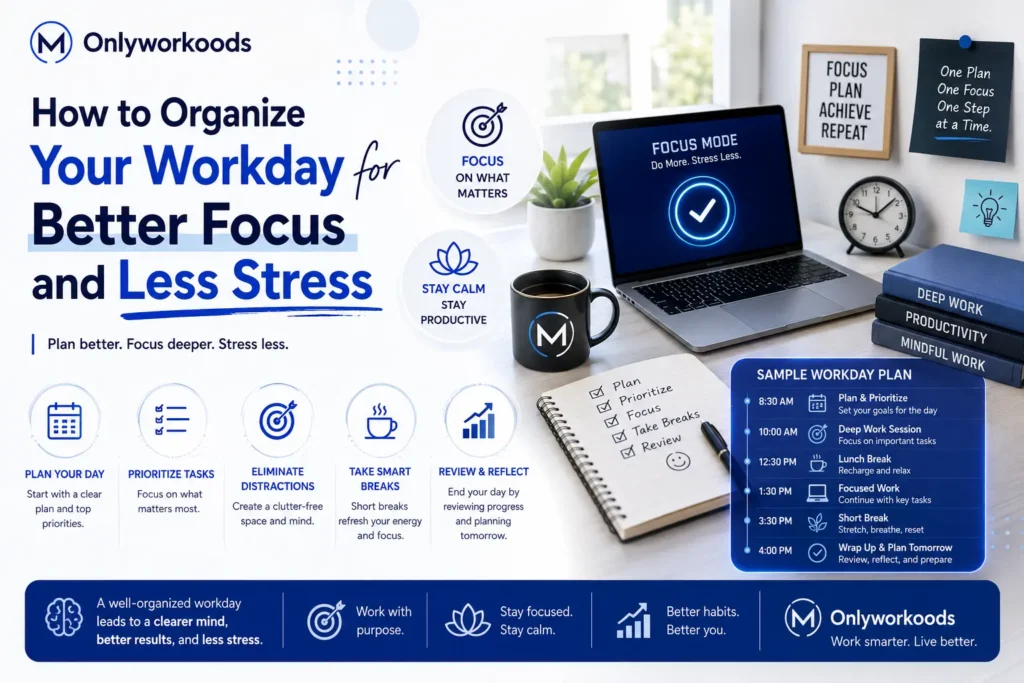
Onlyworkoods: How to Organize Your Workday for Better Focus and Less Stress.
Introduction
A workday can become difficult when everything seems important at the same time. Emails arrive, meetings appear on the calendar, deadlines move closer, and smaller tasks compete with the work that actually requires your attention.
The answer is not always to work harder. Often, a better approach is to create a simple structure that helps you decide what deserves your attention now and what can wait.
That is where the OnlyWorkMoods approach can be useful. Instead of relying on complicated productivity systems, it focuses on practical habits that make everyday work easier to organize. A clear priority list, a comfortable workspace, fewer interruptions, and a reliable end-of-day routine can all contribute to a more manageable workday.
This guide explains how to put those ideas into practice without turning your schedule into another source of pressure.
What Does an Organized Workday Look Like?
An organized workday is not necessarily one where everything goes exactly according to plan.
Unexpected requests and changes are normal.
Instead, organization means having enough structure to adapt when something changes.
A well-organized day usually includes:
- A clear primary priority
- A realistic task list
- Time for focused work
- Space for communication
- Reasonable breaks
- Flexibility for unexpected tasks
- A clear end-of-day routine
The objective is simple: know what matters without trying to control every minute.
1. Begin With Your Calendar
Before creating your task list, look at your calendar.
Identify:
- Meetings
- Appointments
- Deadlines
- Fixed commitments
- Available focus periods
This gives you a realistic picture of the time you actually have.
For example, if your morning contains several meetings, it may not make sense to schedule a large project during every available gap. Instead, reserve a longer uninterrupted period later in the day if possible.
Your calendar should help you understand your capacity—not make you feel guilty about everything you cannot fit into it.
2. Choose One Main Goal
A long task list can create the illusion that everything needs to happen immediately.
Instead, choose one main objective for the day.
Ask:
If I could make meaningful progress on only one thing today, what should it be?
That becomes your anchor.
You can still complete smaller tasks, but having one clear priority gives your day direction.
3. Create a Realistic Task List
After selecting your main goal, list the other things you need to handle.
A useful structure is:
High Priority
Tasks that have meaningful deadlines or consequences.
Normal Priority
Important work that should be completed but does not require immediate attention.
Later
Tasks that can wait without creating a problem.
This prevents every task from being labeled “urgent.”
4. Break Large Projects Into Smaller Actions
“Finish the project” is often too vague to be useful.
Instead, divide the project into specific actions.
For example:
Large task: Prepare a presentation.
Smaller actions:
- Review the available information.
- Create the presentation structure.
- Draft the main points.
- Add supporting information.
- Review the slides.
- Prepare for the presentation.
Smaller actions make progress easier to see and reduce the mental effort required to decide what to do next.
5. Protect Your Best Focus Time
Most people have certain periods when concentrating feels easier.
For some, that may be early in the day. For others, it could be later.
Pay attention to your own pattern.
When you identify your strongest focus period, use it for work that requires more attention.
Good candidates include:
- Writing
- Planning
- Analysis
- Problem-solving
- Strategy
- Detailed review
Try not to automatically spend your best concentration period answering routine messages if the work can wait.
6. Create a Communication Window
Email and workplace messages can easily become a constant background activity.
Instead of checking every message immediately, create reasonable periods for communication where your role allows it.
For example:
Morning: Review urgent communication.
Midday: Respond to routine messages.
Afternoon: Handle remaining follow-ups.
This approach is not suitable for every job. Some roles require immediate responses.
If instant communication is not essential, however, creating boundaries can make focused work easier.
7. Keep Your Workspace Simple
An organized workday becomes easier when your physical environment is also manageable.
You do not need a picture-perfect office.
Start with the basics:
- Keep your desk reasonably clear.
- Put frequently used items within reach.
- Remove unnecessary papers.
- Keep cables and equipment organized.
- Make sure your chair and screen setup are comfortable.
- Keep only the tools you actually use nearby.
The goal is not aesthetics.
The goal is reducing small distractions and unnecessary searching.
8. Use Digital Organization to Save Time
Digital clutter can be just as frustrating as physical clutter.
Create simple rules for your files.
For example:
Projects → Client/Team → Project Name → Documents
Use descriptive file names rather than vague names such as:
- final.doc
- newfile.doc
- document2.doc
Instead, use names that tell you what the file contains.
A few minutes of organization can make future searches much easier.
9. Avoid Switching Between Tasks Too Frequently
Imagine spending ten minutes writing, then checking email, then answering a message, then returning to the document, then checking another notification.
You may technically be working the entire time, but your attention is constantly moving.
Whenever practical, give tasks uninterrupted periods.
For example:
Focus work → communication → focus work → administration
The exact structure depends on your job.
The key is to reduce unnecessary switching.
10. Use Breaks as Reset Points
A break does not need to be complicated.
You might:
- Stand up
- Walk around
- Get water
- Stretch
- Step away from your screen
- Take a few quiet minutes
The important part is creating a distinction between periods of concentrated work.
When you return, take a moment to identify the next action instead of immediately opening every notification.
11. Leave Space Between Priorities
One mistake in workday planning is scheduling tasks back-to-back with no flexibility.
If one task takes longer than expected, the entire schedule can collapse.
Instead, leave some breathing room.
For example:
| Time Block | Activity |
|---|---|
| Start of day | Planning and priority review |
| Focus period | Main project |
| Buffer | Unexpected tasks |
| Communication | Email and messages |
| Focus period | Secondary project |
| Administration | Smaller tasks |
| End of day | Review and planning |
The exact schedule does not matter as much as having room to adapt.
12. Learn to Say “Not Yet”
Being organized does not mean saying yes to everything immediately.
Sometimes the right response is:
“I can handle this, but not immediately.”
When another task arrives, consider:
- Is it genuinely urgent?
- What deadline does it have?
- What current task would need to move?
- Can someone else handle it?
- Does the request require action today?
This creates a more realistic workload.
13. Don’t Let Small Tasks Take Over the Day
Small tasks are easy to complete, which can make them attractive when larger work feels difficult.
You might spend an hour responding to minor messages while avoiding an important project.
Try grouping smaller tasks together.
For example:
Administrative block
- File documents
- Respond to routine messages
- Update records
- Complete simple follow-ups
Then return to your higher-value work.
14. Create an End-of-Day Checklist
Your workday should have a clear closing routine.
Before finishing, check:
- What did I complete?
- What remains unfinished?
- What needs to happen tomorrow?
- Did anything important arrive today?
- What is tomorrow’s first priority?
Write down the answers.
This prevents unfinished tasks from constantly occupying your thoughts after working hours.
A Practical OnlyWorkMoods Workday System
You can combine everything into five simple stages.
Stage 1: Plan
Check your calendar and choose your main priority.
Stage 2: Focus
Work on the most important task without unnecessary interruptions.
Stage 3: Communicate
Set aside appropriate periods for messages, email, and collaboration.
Stage 4: Reset
Take reasonable breaks and reorganize when priorities change.
Stage 5: Close
Review your progress and prepare for the next workday.
This system is intentionally flexible.
The OnlyWorkMoods philosophy is not about creating a rigid schedule that leaves no room for real life. It is about creating enough structure to make everyday work easier.
What to Do When Your Plan Fails
Every workday will not go according to plan.
A meeting may run long. A deadline may change. A technical problem may appear.
When that happens, avoid trying to complete your original plan exactly as written.
Instead:
- Identify what changed.
- Decide what is now most important.
- Remove or postpone lower-priority work.
- Communicate changes when necessary.
- Continue with the revised plan.
A useful routine is one that can survive an imperfect day.
Common Workday Organization Mistakes
Making an Unrealistic To-Do List
A huge list can create unnecessary pressure.
Scheduling Every Minute
A rigid schedule has little room for unexpected work.
Checking Communication Constantly
Frequent interruptions can break periods of concentration.
Keeping Tasks in Your Head
Written notes are easier to review and prioritize.
Trying to Fix Everything at Once
Changing too many habits simultaneously can make a new routine difficult to maintain.
Working Without a Closing Routine
Without a clear finish, unfinished work can follow you into your personal time.
How to Improve Your Routine One Habit at a Time
You do not need to completely redesign your workday.
Try this gradual approach:
Week 1
Choose one daily priority.
Week 2
Create focused work periods.
Week 3
Organize your communication windows.
Week 4
Introduce an end-of-day review.
At the end of the month, consider which changes actually helped.
Keep those habits and remove the ones that did not fit your working style.
FAQ
How can I organize my workday better?
Start by choosing one main priority and creating a realistic list of supporting tasks. Then organize focused work, communication, breaks, and administrative tasks around your available time.
What should I do first when I start work?
Begin by reviewing your calendar and identifying your most important task. This gives you a clear direction before smaller requests and notifications begin competing for your attention.
How can I stay focused during work?
Protect specific periods for uninterrupted work whenever your job allows it. Silence unnecessary notifications, close unrelated tabs, and avoid switching between unrelated tasks during those periods.
Should I check email throughout the day?
You do not necessarily need to check email continuously unless your role requires immediate responses. Where possible, setting specific communication periods can help protect your concentration.
How can I stop feeling overwhelmed by my task list?
Separate your tasks according to priority instead of treating everything as equally urgent. Choose what genuinely needs attention today and move lower-priority tasks to a later list.
What is the best way to end a workday?
Review your progress, record unfinished tasks, and identify tomorrow’s first priority. A consistent closing routine creates a clearer boundary between work and personal time.
Conclusion
A well-organized workday is not about fitting more tasks into fewer hours.
It is about making better decisions about where your attention goes.
Choose a clear priority. Break large projects into manageable actions. Protect focused work periods. Group routine tasks. Give communication reasonable boundaries. Leave room for unexpected work and create a reliable end-of-day routine.
These small changes can make your working hours feel more structured without making your schedule unnecessarily complicated.
That is the core idea behind OnlyWorkMoods: build a way of working that is productive, practical, and realistic enough to use every day.
Start with one change this week and see how it affects your routine. If it makes your workday easier, keep it—and build from there.