
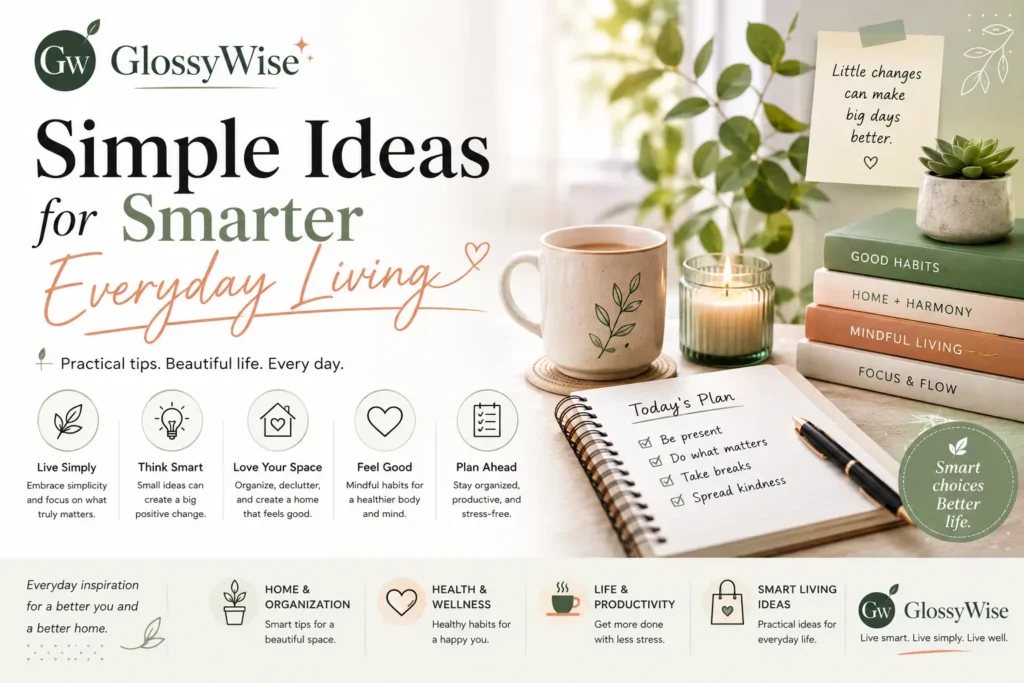
GlossyWise: Simple Ideas for Smarter Everyday Living.
Introduction
Good living does not always require major changes. Often, a few practical adjustments to the way we organize our time, manage responsibilities, use technology, and approach everyday choices can make life feel considerably easier.
GlossyWise represents a simple approach to everyday living: look for useful ideas, keep what works, and avoid unnecessary complexity. Whether you want to improve your routine, organize your surroundings, make better decisions, or create more room for the things you enjoy, small changes can provide a useful starting point.
This guide explores practical ways to make everyday life more manageable without turning improvement into another demanding task. The goal is not perfection. It is about finding realistic habits and systems that fit naturally into your day.
What Does GlossyWise Mean for Everyday Living?
GlossyWise can be viewed as an approach to making everyday life simpler, more organized, and more intentional.
Instead of trying to completely redesign your lifestyle, the idea is to identify areas that regularly create friction and improve them one at a time.
That might mean:
- Organizing your workspace
- Simplifying your morning routine
- Reducing unnecessary digital clutter
- Planning important tasks ahead
- Creating better boundaries around work
- Making your home easier to manage
- Being more deliberate about how you spend free time
- Developing practical habits that are easy to maintain
The most useful lifestyle improvements are often the ones you can continue using after the initial motivation disappears.
Why Simple Changes Can Make Daily Life Easier
Everyday life contains dozens of small decisions. What should you do first? Where did you put something? Which task needs attention? When should you respond to a message?
Individually, these decisions may seem insignificant. Together, they can make a day feel unnecessarily complicated.
A simple system can remove some of that friction.
For example, instead of deciding every morning what needs to be done, you can spend a few minutes identifying your most important tasks the night before. Instead of searching through dozens of digital files, you can establish a consistent folder structure.
The objective is not to control every minute of the day. It is to make common tasks easier.
1. Start With the Areas That Cause the Most Friction
One of the easiest ways to improve your lifestyle is to stop trying to improve everything at once.
Think about the parts of your day that repeatedly cause frustration.
Ask yourself:
- What do I regularly spend too much time looking for?
- Which tasks do I keep postponing?
- What part of my routine feels unnecessarily complicated?
- Which responsibilities regularly interrupt my concentration?
- Where does clutter accumulate?
- Which digital habits distract me?
Choose one area first.
If your mornings are chaotic, start there. If your digital files are difficult to manage, begin with them. If your workspace makes it hard to concentrate, reorganize that area.
A focused improvement is easier to test and maintain than a complete lifestyle overhaul.
2. Build Routines Around Existing Habits
A new habit can be easier to remember when it is connected to something you already do.
For example:
Existing habit → New action
- After breakfast → review the day’s priorities
- After finishing work → clear your workspace
- Before going to bed → prepare for the next morning
- After opening your laptop → check your planned tasks
- After returning home → put frequently used items in their usual places
This approach reduces the need to constantly remind yourself about the new behavior.
The goal is to make useful actions feel like a normal part of your routine rather than another item on a long checklist.
3. Make Your Workspace Easier to Use
Your surroundings can influence how easily you complete routine tasks.
A practical workspace does not need to look perfect. It simply needs to support what you actually do.
Start with the basics:
- Remove items you rarely use.
- Keep frequently used objects within easy reach.
- Give important items a consistent location.
- Keep unnecessary papers and objects from accumulating.
- Make sure your digital workspace is also organized.
For people who work from home, this can be especially useful. A clear distinction between work materials and personal items can make it easier to transition between different parts of the day.
4. Create a Short Daily Priority List
A huge task list can make a productive day feel overwhelming.
Instead, create a short list of the things that genuinely deserve attention.
Try a three-level system
Must do:
Tasks that are important and time-sensitive.
Should do:
Tasks that matter but can move if necessary.
Could do:
Optional tasks that are useful when time and energy allow.
This gives your day some structure without requiring you to complete every possible task.
It also helps distinguish between being busy and making meaningful progress.
5. Simplify Your Digital Life
Digital clutter can be just as distracting as physical clutter.
Your phone, computer, email inbox, cloud storage, and messaging apps can quickly become difficult to manage if everything accumulates without a system.
A simple digital cleanup can include:
- Deleting files you no longer need
- Creating clear folders
- Renaming important documents consistently
- Removing unused apps
- Organizing browser bookmarks
- Unsubscribing from unnecessary emails
- Turning off nonessential notifications
You do not need to organize everything in one sitting.
Choose one digital area and spend a short amount of time improving it. Then move to another area later.
6. Use Technology as a Tool, Not a Constant Distraction
Technology can make daily life easier when it solves a specific problem.
Calendars can help you remember commitments. Notes apps can capture ideas. Task managers can organize responsibilities. Cloud storage can make files accessible across devices.
But adding more apps does not automatically make life more organized.
Before adopting a new tool, ask:
What problem will this solve?
If you cannot identify a clear benefit, you may not need another system.
The best digital setup is often the simplest one that reliably works for you.
7. Make Everyday Decisions Easier
Some decisions happen repeatedly, such as what to eat, what to wear, when to complete routine tasks, or where commonly used items should go.
You can reduce unnecessary decision-making by creating simple defaults.
For example:
- Keep frequently used items in fixed locations.
- Maintain a short list of reliable meals.
- Create a basic weekly planning routine.
- Use recurring reminders for regular responsibilities.
- Keep a small list of trusted options for common purchases.
This does not mean removing spontaneity from your life. It simply makes repetitive decisions less demanding.
8. Protect Time for Activities You Actually Enjoy
A well-organized lifestyle should not be entirely focused on work and responsibilities.
Free time matters too.
Instead of waiting for a completely free day, identify small periods during the week that can be used for activities you enjoy.
That could include:
- Reading
- Walking
- Cooking
- Sports
- Music
- Creative hobbies
- Spending time with friends
- Watching a favorite show
- Exploring a new interest
Scheduling enjoyable activities may sound overly structured, but it can prevent them from continually being pushed aside by other responsibilities.
9. Learn to Say No to Unnecessary Complexity
Not every opportunity, task, purchase, commitment, or trend deserves your attention.
A useful question is:
Does this genuinely improve my life, or does it simply add another thing to manage?
This can apply to many areas.
You may not need another productivity app. You may not need to follow every new lifestyle trend. You may not need to maintain an unnecessarily complicated routine.
Simplification is often about removing what is not useful.
10. Create Systems That Work on Busy Days
A routine that works only when everything goes perfectly is difficult to maintain.
Instead, create a minimum version of important habits.
For example:
- Instead of a long workout, take a short walk when your schedule is crowded.
- Instead of completely reorganizing your home, clear one small area.
- Instead of planning your entire week, identify tomorrow’s priorities.
- Instead of cleaning everything at once, handle one category of clutter.
This makes your systems more flexible.
A useful routine should survive ordinary busy days rather than requiring ideal conditions.
GlossyWise Everyday Living Checklist
Use this quick checklist to identify areas where you can simplify your routine.
| Area | Simple Improvement |
|---|---|
| Morning routine | Prepare important items the night before |
| Workspace | Keep frequently used items accessible |
| Tasks | Choose a short list of priorities |
| Digital files | Create consistent folders |
| Remove unnecessary subscriptions | |
| Phone | Reduce nonessential notifications |
| Home | Give common items permanent places |
| Free time | Reserve time for enjoyable activities |
| Decisions | Create simple defaults |
| Planning | Review the next day before finishing the current one |
You do not need to apply every suggestion. Start with the one that addresses your biggest everyday problem.
How to Create Your Own GlossyWise Routine
A practical routine can be built in five steps.
Step 1: Identify one problem
Choose something that repeatedly wastes time or creates frustration.
Step 2: Find the simplest solution
Avoid creating a complicated system for a small problem.
Step 3: Test it
Use the new approach consistently for a while and see whether it actually helps.
Step 4: Adjust it
If something feels inconvenient, modify the system instead of immediately abandoning it.
Step 5: Keep only what works
A routine should serve you. If a particular habit consistently adds unnecessary effort without a useful result, reconsider it.
Common Mistakes to Avoid
Trying to change everything at once
A complete lifestyle transformation can sound exciting, but too many changes can quickly become difficult to maintain.
Copying someone else’s routine
A system that works for another person may not fit your schedule, responsibilities, or preferences.
Using too many tools
More apps, planners, and systems can create more maintenance instead of reducing it.
Chasing perfection
Missing one day does not mean a routine has failed. Good systems should allow room for ordinary interruptions.
Ignoring what you actually enjoy
Productivity and organization are useful, but they should support a satisfying life rather than replace it.
A Practical Example of GlossyWise Living
Imagine someone who regularly starts work without knowing what needs attention, spends time searching for files, and finishes the day feeling like nothing important was completed.
A simple approach could look like this:
Before work:
Review three priorities.
During work:
Keep frequently used files in clearly labeled folders.
After work:
Spend a few minutes clearing the workspace and noting unfinished tasks.
Evening:
Prepare essential items for the next morning.
None of these steps requires a dramatic lifestyle change. Together, they can create a clearer transition between different parts of the day.
That is the practical idea behind GlossyWise: make everyday systems easier to use and easier to maintain.
How GlossyWise Can Apply to Different Lifestyles
There is no single definition of a well-organized life.
For students
Focus on:
- Simple study schedules
- Organized notes
- Consistent study spaces
- Fewer digital distractions
For professionals
Focus on:
- Daily priorities
- Calendar management
- Organized files
- Clear work boundaries
For parents and families
Focus on:
- Shared routines
- Simple household systems
- Planning recurring responsibilities
- Keeping frequently used items accessible
For busy individuals
Focus on:
- Reducing unnecessary commitments
- Automating repetitive tasks where practical
- Creating simple defaults
- Protecting personal time
The same principle applies across different lifestyles: build systems around your real life, not an imaginary perfect schedule.
FAQ: GlossyWise and Everyday Living
What is GlossyWise?
GlossyWise can represent a practical approach to smarter everyday living through simple routines, organization, thoughtful decisions, and useful habits. The emphasis is on realistic improvements rather than complicated lifestyle systems.
How can I make my daily routine easier?
Start by identifying one recurring source of friction and create a simple solution for it. Small changes such as preparing for the next day, organizing frequently used items, or setting daily priorities can make routines easier to manage.
How do I become more organized without feeling overwhelmed?
Focus on one area at a time instead of trying to organize your entire life immediately. Choose a small problem, create a simple system, test it, and adjust it based on what actually works.
Can GlossyWise ideas help with digital organization?
Yes, GlossyWise principles can be applied to digital organization by creating clear folders, removing unnecessary files, reducing notifications, and keeping frequently used information easy to access. The goal is to make your digital environment easier to navigate.
What is the simplest way to improve everyday productivity?
Choose a small number of meaningful priorities instead of filling your day with an endless task list. A clear plan combined with realistic expectations can make it easier to focus on important work.
Does a better lifestyle require major changes?
No, meaningful improvements can come from small, consistent changes. Simplifying routines, organizing your environment, and making intentional choices can improve everyday experiences without completely changing your lifestyle.
Conclusion
GlossyWise is ultimately about making everyday life more manageable without making it more complicated.
Start small. Improve the areas that create the most friction, build routines around habits you already have, organize the spaces and tools you use regularly, and leave room for activities that make your life enjoyable.
The best lifestyle system is not necessarily the most impressive one. It is the one that fits your life, reduces unnecessary effort, and remains useful when the week gets busy.
Choose one GlossyWise idea from this guide and put it into practice. Once it becomes natural, you can build from there.